The Anthropologist as Anti-Hero: Masculinity’s Misperformance and the Death of William Jones, 1909
Juan Fernandez
Assistant Professor of Southeast Asian History
Department of History
University of Wisconsin—Madison
The Anthropologist as Anti-Hero: Masculinity’s Misperformance and the Death of William Jones, 1909
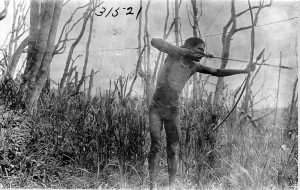
The death of the American anthropologist William Jones in 1909 while on an expedition among the Ilongot (Bugkalot) for the Field Museum of Natural History is a minor but recurrent theme in the history of Philippine anthropology. Having spent seventeen months’ fieldwork in the upper reaches of the Cagayan Valley, and on the eve of his departure, Jones was set upon by four Ilongot men who attacked to prevent Jones from forcing a respected elder onto a raft and thence to take him downriver to “punish” him for breaking a promise made to Jones. I analyze Jones’s fatal encounter within a historical ethnographic reconstruction of the Ilongot gender matrix in the early twentieth century using Jones’s field-notes, diaries, and correspondence. My argument rests on Jones’s misperformance of masculinity among the Ilongots: where, instead of adhering to the ideal, egalitarian ethos of the Ilongot community, Jones used physical force to exert his will rather than the culturally valorized idiom of persuasive speech. Jones’s death and its consequences therefore bring to light a contradiction within an American colonial ideology that ascribes violence and force to so-called savage peoples, and reason and order in the practices of the scientist in the field. I focus on the encounter between the anthropologist and his Indigenous interlocutors, and foreground the intersubjective relationships formed in the field, through the misperformance of masculinity.
Speaker Bio:
Juan Fernandez focuses on the histories of sex, gender, and ethnography in the highlands of the Philippines in the early twentieth century. His first book project, “Manly Encounters,” examines how ethnographic fieldwork conducted by the earliest generation of professional American anthropologists was intertwined with their attempts to perform (to varying degrees of success) their approximation of Indigenous Philippine masculinity. This first project is part of a larger set of research questions that seek to analyze the emergence of the category of the Southeast Asian “headhunter”—in the Philippines, but also in Malaysian and Indonesian Borneo—in terms of its gendered dimensions and the almost invariable ascription of masculinity to the Indigenous peoples who once practiced it. His second project, tentatively titled “The Anatomy of a Hoax,” examines the history of the supposed anthropological “discovery” in the 1970s of the Tasaday in the southern Philippines. Juan Fernandez also teaches lectures and seminars on modern Southeast Asia, the history of colonial photography in the region, Southeast Asian ethnohistory, as well as histories of childhood, the family, and gender and sexuality.