Chasing Blessings:
Sensory Islam and Ontologies of Presence
in Southeast Asia
Jamie Edmonds
Director, Critical Languages Institute
Associate Director, Melikian Center: Russian, Eurasian, and East European Studies
Clinical Assistant Professor, Religious Studies
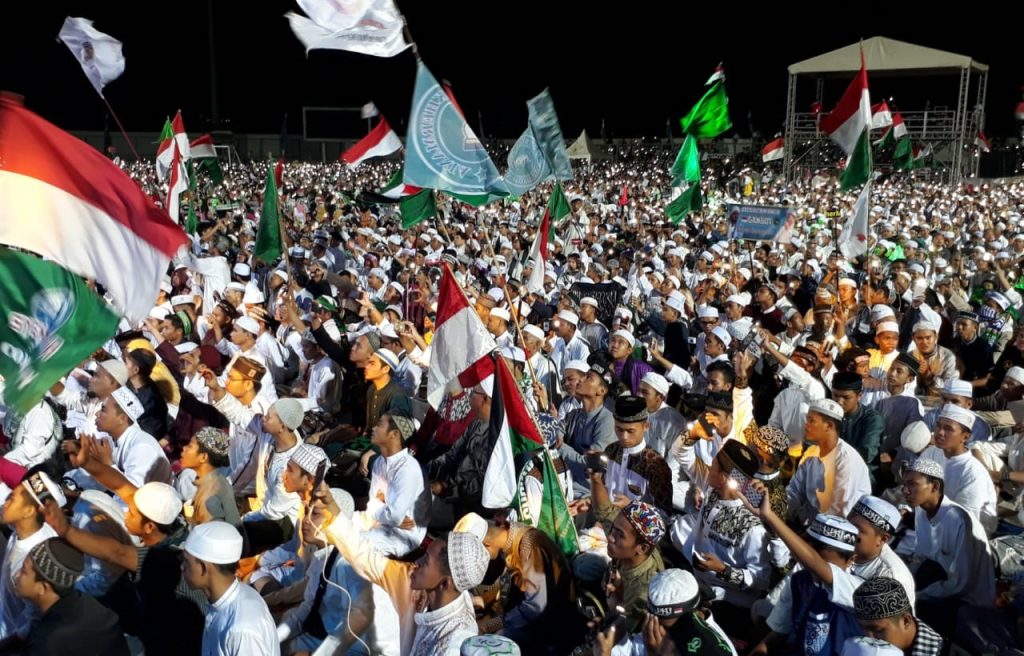
Since 1998, Habib Syech bin Abdul Qadir Assegaf (Habib Syech) has brought millions of people together across Indonesia, Malaysia, Taiwan, Hong Kong, Thailand, South Korea, Egypt, Saudi Arabia, and Yemen through performances of Islamic devotional songs. In the Southeast Asian context, his widespread popularity, devoted following, and extensive touring might be compared to those of the Grateful Dead. His performances create a vibrant cacophony of sensory experience: the fragrance of burning agarwood, sweeping laser lights, tens of thousands of participants singing in unison, and networks of vendors who follow the performances from one location to the next. Yet these gatherings extend beyond their religious, political, cultural, and economic dimensions. Drawing on long-term ethnographic research in Indonesia, Jamie Edmonds explores how Habib Syech’s performances reveal different ways of understanding the relationship between the visible and the invisible, the material and the ineffable. What happens when the ethnographer is not simply observing these gatherings but becomes entangled in their rhythms, sensations, stories, and movements? Moving through stadiums, fields, rice paddies, roads, crowds, scents, sounds, and devotional practices, this presentation considers how such encounters make other ontologies of presence perceptible. Chasing Blessings considers the possibility of a world moved by blessings (baraka), the unseen, and forms of enchantment that resist being reduced to representation or rational explanation.

-
Brief BiographyJames M. Edmonds, Ph.D., is an anthropologist and scholar of religion with extensive fieldwork in Southeast Asia. He is also an international education leader at Arizona State University, where he serves as Director of the Critical Languages Institute, Associate Director of the Melikian Center for Russian, Eurasian, and East European Studies, and Clinical Assistant Professor of Religious Studies. His academic work examines the changing textures of contemporary Indonesian Islamic piety and their relationship to global forms of Islam in Asia, local sociocultural contexts, and the possibilities of (re)centering the ineffable as an object of investigation in the humanities. Although always necessarily incomplete, the ineffable emerges in Edmonds’s work through the ways Indonesian Muslims theorize and experience their own ontologies of presence, particularly through sensory stories of blessing (baraka). Drawing on long-term ethnographic research in Indonesia, Edmonds explores how aesthetic, sensory, material, and sociocultural practices make different modes of presence perceptible and, in doing so, challenge dominant Western assumptions about existence, materiality, and the boundaries between the tangible and intangible. His work asks what becomes visible when scholars take seriously forms of knowledge and presence that resist complete rationalization or representation. Through this approach, his research contributes to conversations in religious studies, anthropology, Southeast Asian studies, and the global humanities about how piety, aesthetics, materiality, and sensory experience complicate conventional understandings of religion and modernity.